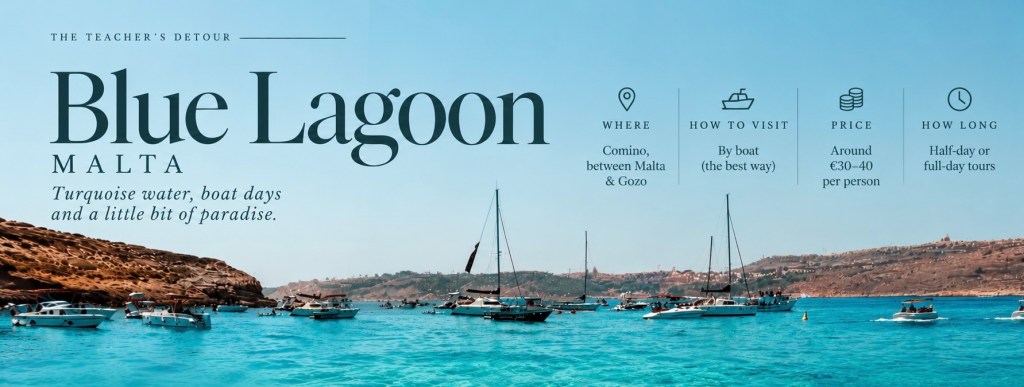
There are places you see so many times on Instagram that, when you finally visit them, you’re almost prepared to be disappointed. The Blue Lagoon was one of those places for me.
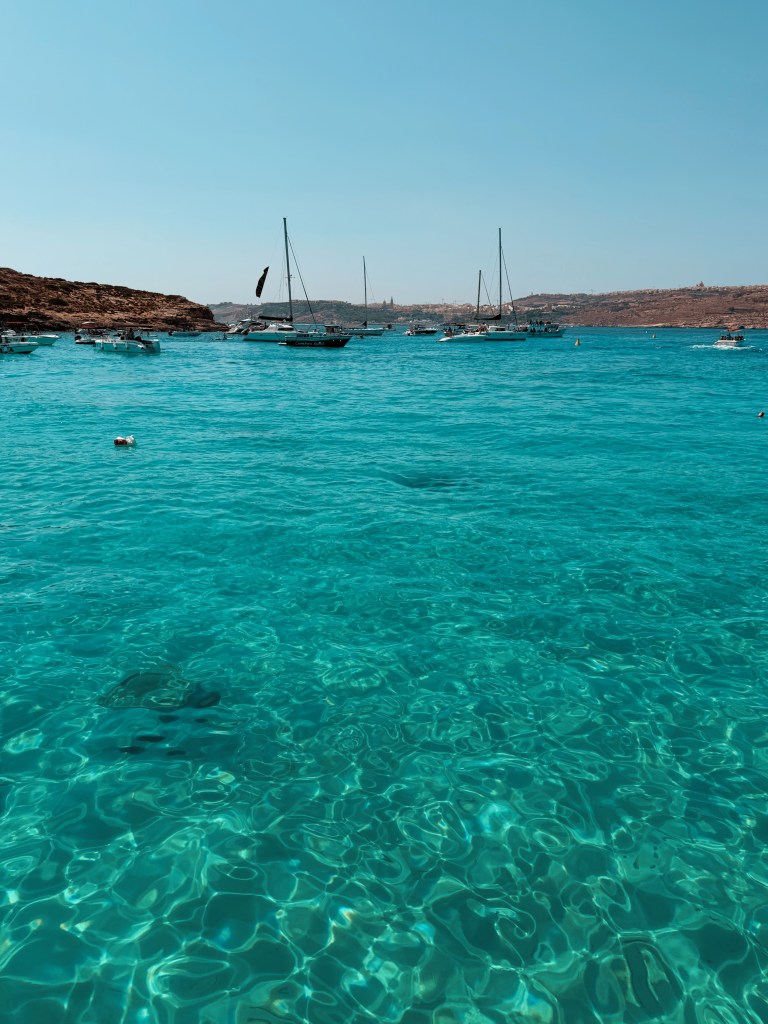
You know the pictures: ridiculously turquoise water, boats apparently floating in mid-air, people swimming in what looks suspiciously like the Caribbean rather than the middle of the Mediterranean. Surely there’s a filter involved.
Well. There isn’t. The Blue Lagoon really is that blue.
But — and you knew there was going to be a but — how you visit it can completely change your experience. And after going there myself, there is one thing I would absolutely do again: visit it by boat.
First things first: where exactly is the Blue Lagoon?
The Blue Lagoon is located on Comino, the tiny island sitting between Malta and Gozo.
The lagoon itself lies between Comino and the even smaller islet of Cominotto, creating a sheltered stretch of shallow water with a pale sandy seabed.
And that seabed is partly responsible for the colour. The sunlight reflects off the light sand underneath the shallow, incredibly clear water, creating that almost unreal turquoise colour you see in photographs. Except that, for once, the photographs aren’t lying.
When the sun hits the water, the colour is genuinely spectacular.
The Instagram expectation vs. the August reality
Now imagine this:
- You arrive in Malta in August.
- It’s hot.
- Everyone has had exactly the same brilliant idea as you.
- And apparently half of Europe has decided that today is Blue Lagoon Day.
- Welcome to reality.
The Blue Lagoon is one of Malta’s most popular attractions, which means that during the summer months it can become extremely crowded. Recent measures were actually introduced specifically to control the number of visitors because, before the new system, peak summer days could see enormous numbers of people gathering around the lagoon.
And this is exactly why I wouldn’t recommend simply getting there, stepping onto Comino and trying to find somewhere to sit near the water.
Technically, you can. Personally? I wouldn’t. TAKE. THE. BOAT.
This is probably my biggest piece of advice about the Blue Lagoon. Instead of treating Comino like a beach destination, treat the Blue Lagoon as a boat day.
There are plenty of organised excursions departing from different parts of Malta, and prices are usually around €30–40 per person, depending on the duration of the trip and the itinerary. We found plenty of options on GetYourGuide, and booking the excursion was incredibly easy.
My advice, especially if you’re travelling in high season, is to book in advance. Not only can the most convenient trips fill up, but prices can increase as availability decreases.
Why I preferred seeing the Blue Lagoon from a boat
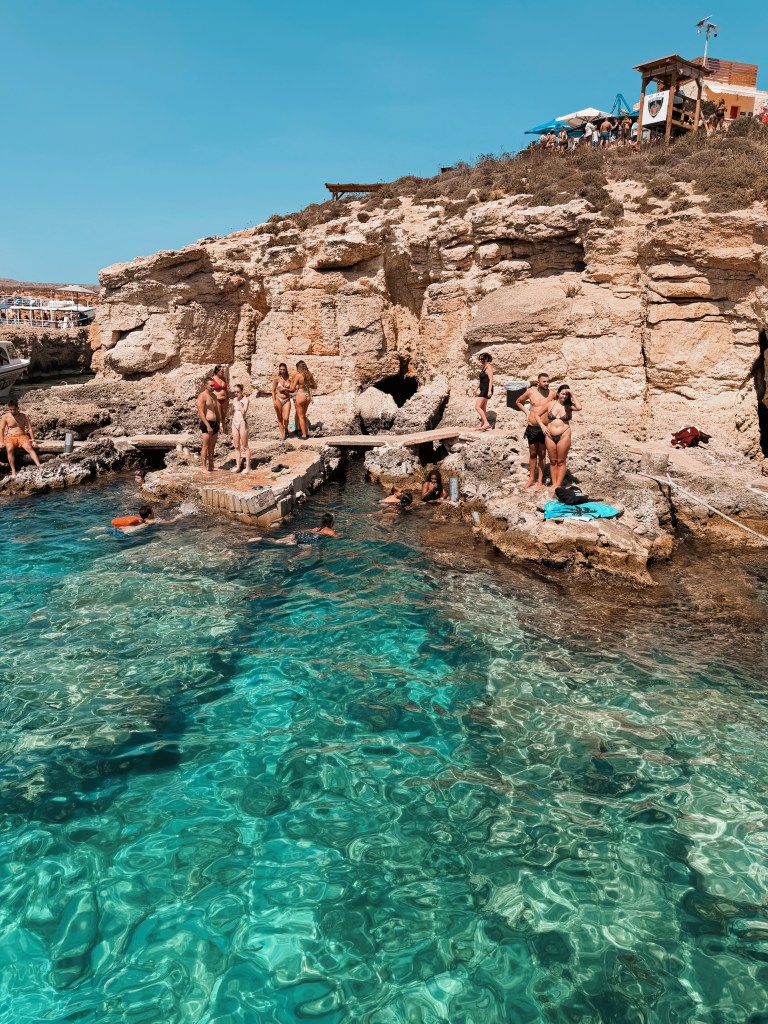
Here’s what nobody really tells you when you’re looking at those perfect pictures online. If you arrive independently and spend your time on land, you’re sharing a relatively small area with a lot of people.
And the swimming experience isn’t necessarily the one you’ve imagined.
With an organised boat excursion, instead, the boat can anchor in the lagoon and you can jump directly into the water from the boat. And that is the Blue Lagoon experience I wanted.
- No fighting for a tiny patch of rock.
- No trying to squeeze a towel between approximately 847 other towels.
- No spending half the day wondering where on earth you’re supposed to leave your bag.
Just:
boat → turquoise water → swim → back on the boat.
Much better.
There is another useful advantage too. Since 2025, visitors who want to set foot on the shore around the Blue Lagoon need to reserve a free time slot in advance and receive a QR code.
There are currently three access periods during the day: morning, afternoon and evening. If your boat simply anchors in the lagoon and you stay on board or swim directly from it, however, you don’t need the landing pass. Yet another point for Team Boat.
And you’re not only paying for the Blue Lagoon. Many excursions don’t simply take you to the Blue Lagoon, leave you there and come back.
Depending on which one you choose, the itinerary can include stops around Gozo, Ramla Bay and the Crystal Lagoon, as well as other caves and swimming spots around Comino.
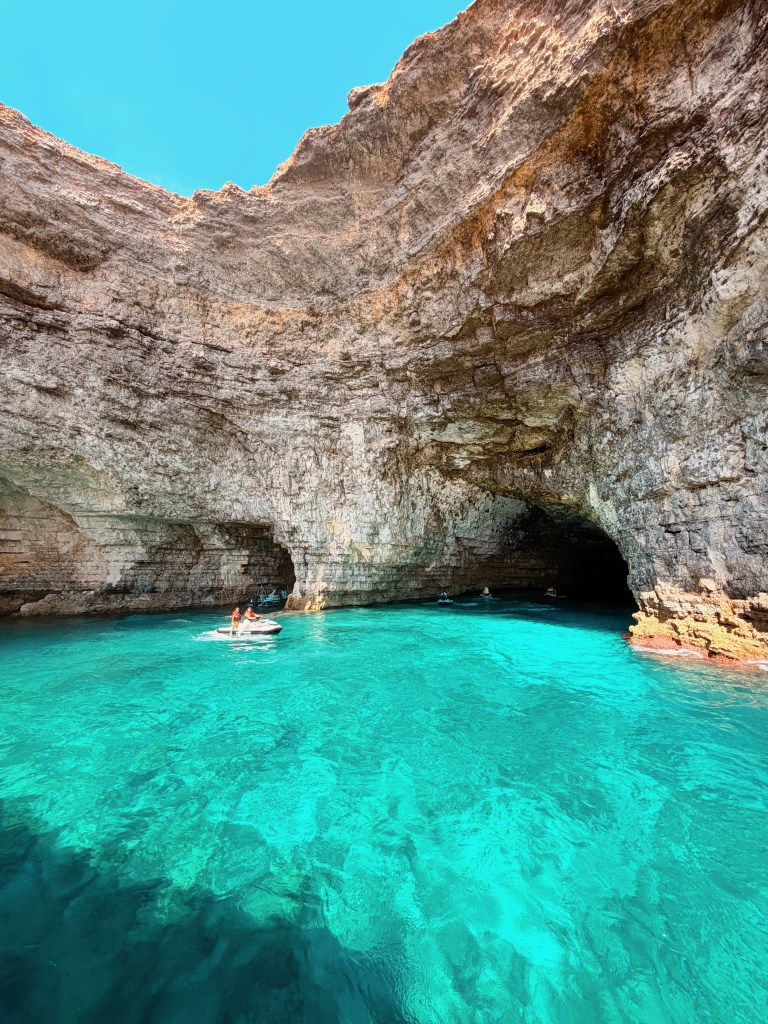
So your €30–40 isn’t necessarily paying for transportation to one famous beach. It can become an entire day exploring this part of the Maltese archipelago. And if your tour includes the Crystal Lagoon, don’t skip it mentally just because it isn’t the famous lagoon. Unlike the shallow, bright turquoise Blue Lagoon, the Crystal Lagoon is deeper and surrounded by cliffs, giving the water a darker, more dramatic blue.
It’s a completely different kind of beautiful. And generally much less chaotic.
A tiny tropical tradition: the pineapple cocktails
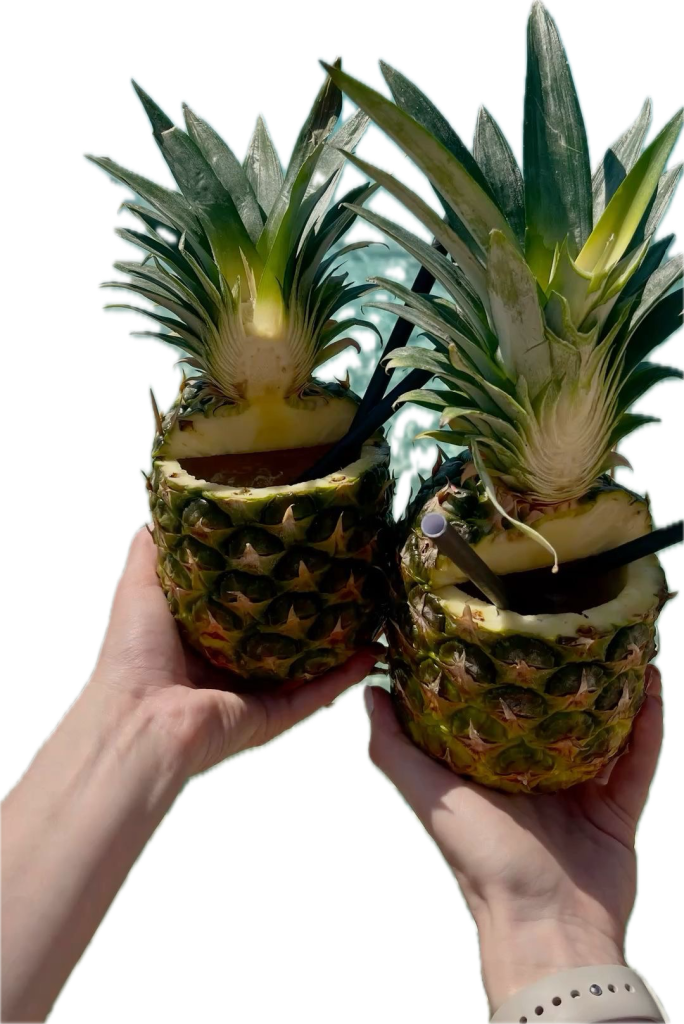
There is one very specific image you’ll probably notice around the Blue Lagoon. People walking around holding pineapples.
No, Malta hasn’t suddenly become Hawaii. Around the lagoon you’ll find kiosks selling cocktails and cold drinks inside hollowed-out pineapples, which have somehow become one of the unofficial photographic souvenirs of the Blue Lagoon.
Is it touristy? Absolutely. Is drinking something cold out of a pineapple while floating around impossibly blue Mediterranean water also quite fun? Also absolutely. Sometimes we can just let ourselves be tourists.
The Blue Lagoon is actually protected
Something I didn’t fully appreciate before visiting is that Comino isn’t simply a beautiful swimming spot. The area forms part of Malta’s Natura 2000 network, which means its ecosystem is protected.
And its popularity has become part of the problem. During peak periods in summer 2024, more than 12,000 visitors could be present around the Blue Lagoon at the same time. Suddenly those crowded Instagram videos make a little more sense.
The Maltese authorities subsequently introduced a new access-management system, limiting the number of people who can be on land around the Blue Lagoon at the same time to 4,000.
So if you’re visiting, remember that this isn’t an amusement park built for tourists. It’s a beautiful — and fragile — natural place that happens to have become extremely famous.
So… is the Blue Lagoon overrated?
I genuinely don’t think it is.
Crowded? Yes. Touristy? Very. One of those places where you’re occasionally surrounded by boats, music, inflatable unicorns and someone carrying a cocktail inside a pineapple? Also yes. But the water?
The water is extraordinary.
And this is one of those rare occasions where I think choosing how you visit matters almost as much as choosing to visit in the first place.
If I went back tomorrow, I wouldn’t hesitate. I’d book a boat excursion, preferably one including the Crystal Lagoon and another stop around Gozo, and I’d spend the day jumping directly into the sea rather than trying to claim a tiny piece of Comino for myself.
What I wish I knew before visiting
If you’re planning your own Blue Lagoon day, here’s the short version:
- Book a boat trip.
- Expect to spend roughly €30–40, depending on the duration and itinerary.
- Book ahead if you’re travelling during the summer, rather than waiting until you’re already in Malta.
- Look for an itinerary that combines the Blue Lagoon with places such as Crystal Lagoon, Gozo or Ramla Bay — you’ll see much more for your money.
- And if you’re planning to get off the boat and explore Comino on foot, remember to check the current Blue Lagoon access system and reserve your landing slot.
Most importantly?
Don’t expect an empty tropical paradise. You’re visiting one of Malta’s most famous places. There will be people. There will be boats. There may very well be pineapples. But when you jump into that ridiculously blue water for the first time, you’ll probably understand why everyone came.
… and now a short Teacher’s Note.
Why is it called the Blue Lagoon?
This is one of those wonderfully straightforward English names where there isn’t a mysterious etymology hiding behind it.
A lagoon is a shallow body of water separated or partly separated from a larger body of water by a natural barrier.
The word itself has travelled much further than you might expect: English lagoon comes from Italian laguna, which ultimately traces back to the Latin lacuna, meaning a pool, hollow or empty space.
So yes — while standing in Malta speaking English, you may be using a word that travelled through Italian first.
Language travels too. And that might be my favourite kind of detour.
-Giulia


Leave a Reply